Air travel safety: how to prepare for a flight (checklist)
⏱ 3 min read
Before the flight, on board and when things go wrong. A guide based on official advice. The same text is in the free SurvivalZone.app and works without internet.
Before you go
- Check your government's travel advice for the country and register your trip with your foreign ministry (e.g. Odyseusz in Poland, Elefand in Germany), so the consulate knows you are there in a crisis.
- Photograph your ID or passport, ticket and insurance policy. Keep them on your phone and send them to someone close.
- Buy insurance that covers treatment and repatriation. Within the EU, also take your EHIC card.
- Pack medicines, glasses, charger and power bank in your cabin bag, not in the suitcase.
- Save the numbers: 112, the airline helpline, your insurer and the nearest consulate.
- Agree with your family how you will say you have landed and what they do if you don't.
On board
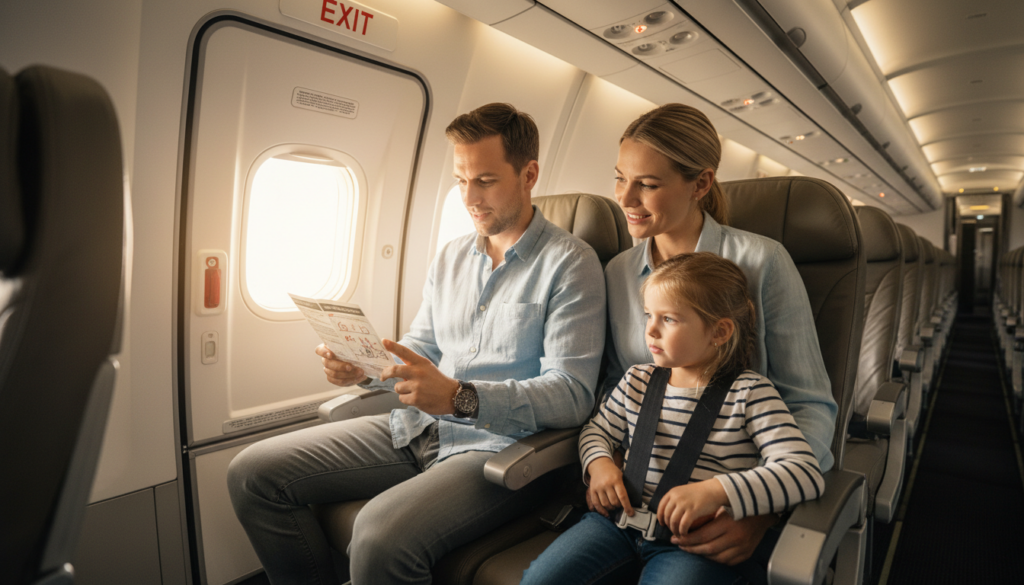
- Listen to the safety briefing and count the rows to the nearest exit, in front and behind.
- Keep your seatbelt fastened whenever you are seated. Turbulence can come without warning.
- On long flights, get up and walk, do calf exercises, drink water and go easy on alcohol. This lowers the risk of blood clots (DVT).
- Had a clot, recent surgery or are pregnant? Ask your doctor about compression stockings before you fly.
When things go wrong
- Evacuating the plane: leave your bags, take off high heels and go to the exit the crew shows you.
- Flight cancelled or delayed by several hours? In the EU you are entitled to care (meals, a hotel) and often to compensation. Keep your boarding pass and receipts.
- Stranded abroad by a strike, disaster or a closed airport: follow your foreign ministry and consulate, not just one source.
- Lost your passport: report it to the police and the consulate. They can issue an emergency travel document.
Watch out
- Never take your bags in an aircraft evacuation. Every second in the aisle can cost someone's life.
- Don't pack power banks or spare batteries in checked luggage. They must go in your cabin bag.
See also
Frequently asked questions
What should I pack in my cabin bag in case of problems?
Medicines for a few days longer than the trip, documents and copies, charger, power bank, glasses and a change of underwear. A suitcase can arrive late or not at all.
How do I avoid DVT on a long flight?
Get up and walk, do calf exercises, drink water and limit alcohol and sleeping pills. People at higher risk should ask a doctor about compression stockings.
What am I entitled to if my flight is cancelled?
In the EU the airline must provide care (meals and, if needed, a hotel) and offer a refund or another flight. Compensation is often due as well.
Why register my trip with the foreign ministry?
In a disaster, attack or evacuation the consulate knows you are in the country and can contact you.
Related topics
- ✈️ Diverted or cancelled flight, closed airport
- 🌋 Volcanic eruption and ash
- 🌋 Travelling near volcanoes
- 🏜️ Desert trip safety
📩 Free 72-hour plan by email
A 72-hour shopping and go-bag list, plus a short monthly checklist. Free, no spam.
Keep it on your phone
SurvivalZone.app is a free app for every emergency, with no account and no app store. It works without internet and shows the nearest shelters and help points, local radio, a 72-hour plan and a mountain trip planner.
Thank you for reading. If this could help someone, send it to the people you care about. Getting ready takes a moment, and in a crisis every minute counts.
Coming soon: the app’s permanent address will be survivalzone.app.
Other guides
- 💧 How to make water safe
- 🍲 Food without power
- ⛺ Shelter at home and outdoors
- 👨👩👧 Protecting your family and yourself
- 💊 Run out of medicine
- 🎒 Go bag checklist
- 🩹 Home first aid kit
- 🔦 Prepare your home for a blackout
- 🏜️ Desert trip
- 🪢 Knots worth knowing
- 🔥 Campfire and outdoor cooking
- 🧭 Survival kit for your backpack
- 📞 Family communication plan
- 🥫 Emergency food and medicine supplies
- 🧼 Hygiene in a crisis
- 📁 Documents and money in a crisis
- 🧰 Tools and equipment for a crisis
- 🧥 Clothing and warmth in a crisis
- 📻 Communication and navigation in a crisis
- 🥶 Home ready for frost
- 🌊 Prepare your home for floods
- 🔥 Fire safety at home
- 🌡️ Get ready for a heatwave
- ⛈️ Storm-proof your home
- 🚀 Shelter for an air raid
- 📢 Sirens and alerts
- ❤️ Learn CPR and find an AED
- 🌍 Prepare for earthquakes
- ⛵ Safe sailing at sea
- 🚗 Car ready for an accident
- ☠️ Carbon monoxide and gas alarms
- ❄️ Winter car kit
- 🌩️ Mountain storms: plan your hike
- 🫀 Heart attack and stroke signs
- 🏊 Water safety
- 🌲 Prevent wildfires
- 🦠 Prepare for an epidemic or pandemic
- 🧒 If your child gets lost
- 🫁 Prevent choking
- 🩸 Kit for severe bleeding
- 🔥 Prevent burns
- 😷 Smog: protect your health
- 🐻 Bears: avoid encounters
- 🐗 Wild boar: avoid encounters
- 🏢 Evacuation at work
- 🌪️ Shelter from a tornado
- 🌧️ Protect your basement from flash floods
- ☣️ Chemical incident: prepare your home
- 🏠 Quarantine at home
- 🛡️ Secure your phone and accounts
- 🔌 Your fuse box: get ready in advance
- 💨 Gas at home: a safe installation
- 😵💫 Fainting: how to prevent it
- 🏫 School and emergencies: prepare your child and family
- 🏜️ Drought: how to prepare your home and garden
- 🌋 Travelling near volcanoes: how to prepare
- 🛴 Riding an e-scooter safely
- 🛑 Attacker at school: how to prepare your child
- 🔔 Smoke and CO alarms: a home ready for the alarm
- 🔥 Campfire: types and ways to light one
Sources
- Your Europe (EU): passenger rights
- EASA: can I move freely in the aeroplane?
- NHS: deep vein thrombosis (DVT)
- Polish Foreign Ministry: travel advice by country
- Polish Foreign Ministry: Odyseusz trip registration
- German Foreign Office: Elefand crisis registration list
Official sources are checked automatically every day. Last check: 2026-11-08.
General guidance only; it does not replace the emergency services. If a life is in danger, call 112.
© 2026 SurvivalZone.EU. Copying this content without permission is prohibited. When quoting, credit the source and link back.