Emergency go bag checklist: what to pack for 72 hours
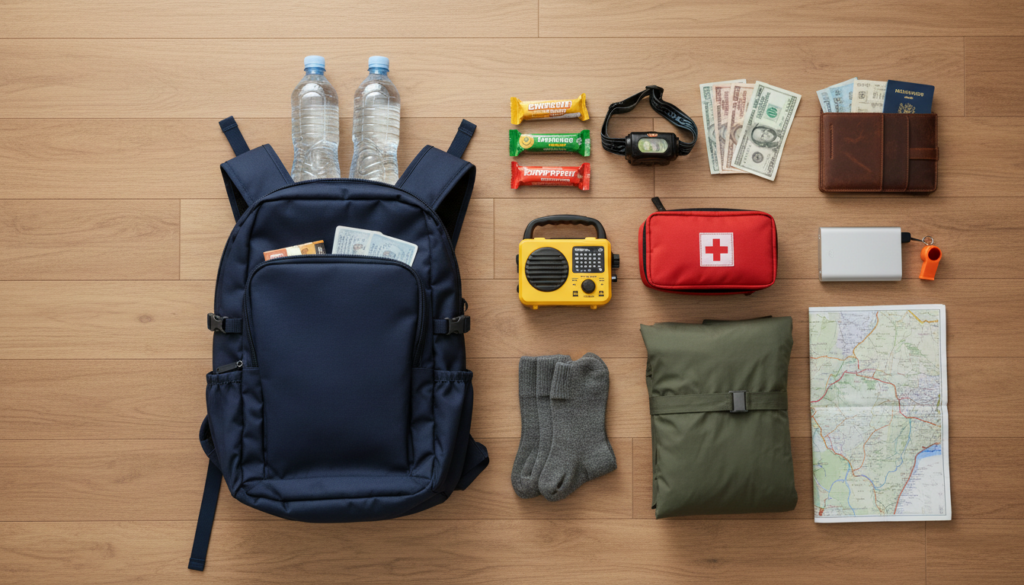
⏱ 3 min read
What to pack when you must leave home fast. A guide based on official advice. The same text is in the free SurvivalZone.app and works without internet.
Rules
- Pack a bag for every member of the household, including children (a lighter one).
- Keep it somewhere easy to grab, ideally near the door.
- Every few months check use-by dates of food, medicines and batteries, and swap clothes for the season.
Water and food
- Bottled water and a filter or water purification tablets.
- Ready-to-eat, light, high-energy food: bars, dried fruit, nuts.
Health and hygiene
- A first aid kit and regular medicines, enough for several days.
- Hygiene and disinfection products, wipes, toilet paper, sanitary pads or nappies if needed.
Documents and money
- Copies of key documents in a waterproof sleeve and on a USB stick.
- Cash in small and large notes.
- On paper: phone numbers of your family and an agreed meeting point.
Light, contact, power
- A torch or head torch and spare batteries.
- A battery or hand-crank radio.
- Phone, a charged power bank, charger and cables.
- A whistle to call for help.
Clothing and sleeping
- A change of clothes for the season and rainwear.
- A sleeping bag or blanket, a mat and a foil emergency blanket.
Tools
- A penknife or multitool, a lighter, bin bags and a printed map of your area.
Children and pets
- For a child: a favourite toy or book, snacks, nappies and formula.
- For a pet: food, a bowl, a lead and its vaccination record.
Watch out
- Keep the bag light. Only pack what you can carry on foot for a long time.
- This list is general. Add what your household needs, such as glasses, a hearing aid or a child's medicines.
See also
Frequently asked questions
What should be in a go bag?
Water and food, a first aid kit and medicines, copies of documents and cash, a torch, a radio, a power bank, spare clothes, a foil blanket, a penknife and a printed map. The full list is above.
How much water should I pack?
Official guides recommend storing 2–3 litres of water per person per day at home. Pack as much water as you can carry in the bag and add a filter or purification tablets.
Where should I keep my go bag?
Somewhere easy to reach near the door, so anyone in the household can grab it in seconds.
Related topics
- ⚡ Power cut
- 🎒 Evacuation in 10 minutes
- 📢 Sirens, alarm, air contamination
- 📁 Emergency documents and cash
- 🥫 Emergency Food Supply
- 🧰 Emergency tools and equipment
📩 Free 72-hour plan by email
A 72-hour shopping and go-bag list, plus a short monthly checklist. Free, no spam.
Keep it on your phone
SurvivalZone.app is a free app for every emergency, with no account and no app store. It works without internet and shows the nearest shelters and help points, local radio, a 72-hour plan and a mountain trip planner.
Thank you for reading. If this could help someone, send it to the people you care about. Getting ready takes a moment, and in a crisis every minute counts.
Coming soon: the app’s permanent address will be survivalzone.app.
Other guides
- 💧 How to make water safe
- 🍲 Food without power
- ⛺ Shelter at home and outdoors
- 👨👩👧 Protecting your family and yourself
- 💊 Run out of medicine
- 🩹 Home first aid kit
- 🔦 Prepare your home for a blackout
- ✈️ Air travel: a safe trip
- 🏜️ Desert trip
- 🪢 Knots worth knowing
- 🔥 Campfire and outdoor cooking
- 🧭 Survival kit for your backpack
- 📞 Family communication plan
- 🥫 Emergency food and medicine supplies
- 🧼 Hygiene in a crisis
- 📁 Documents and money in a crisis
- 🧰 Tools and equipment for a crisis
- 🧥 Clothing and warmth in a crisis
- 📻 Communication and navigation in a crisis
- 🥶 Home ready for frost
- 🌊 Prepare your home for floods
- 🔥 Fire safety at home
- 🌡️ Get ready for a heatwave
- ⛈️ Storm-proof your home
- 🚀 Shelter for an air raid
- 📢 Sirens and alerts
- ❤️ Learn CPR and find an AED
- 🌍 Prepare for earthquakes
- ⛵ Safe sailing at sea
- 🚗 Car ready for an accident
- ☠️ Carbon monoxide and gas alarms
- ❄️ Winter car kit
- 🌩️ Mountain storms: plan your hike
- 🫀 Heart attack and stroke signs
- 🏊 Water safety
- 🌲 Prevent wildfires
- 🦠 Prepare for an epidemic or pandemic
- 🧒 If your child gets lost
- 🫁 Prevent choking
- 🩸 Kit for severe bleeding
- 🔥 Prevent burns
- 😷 Smog: protect your health
- 🐻 Bears: avoid encounters
- 🐗 Wild boar: avoid encounters
- 🏢 Evacuation at work
- 🌪️ Shelter from a tornado
- 🌧️ Protect your basement from flash floods
- ☣️ Chemical incident: prepare your home
- 🏠 Quarantine at home
- 🛡️ Secure your phone and accounts
- 🔌 Your fuse box: get ready in advance
- 💨 Gas at home: a safe installation
- 😵💫 Fainting: how to prevent it
- 🏫 School and emergencies: prepare your child and family
- 🏜️ Drought: how to prepare your home and garden
- 🌋 Travelling near volcanoes: how to prepare
- 🛴 Riding an e-scooter safely
- 🛑 Attacker at school: how to prepare your child
- 🔔 Smoke and CO alarms: a home ready for the alarm
- 🔥 Campfire: types and ways to light one
Sources
- Ready.gov: Build a kit
- Polish government Safety Guide 2025 (PDF, Polish): go bag p. 27–28, first aid kit p. 22, power cut p. 34
- BBK (Germany): supplies and emergency bag materials
- Government Centre for Security (Poland)
Official sources are checked automatically every day. Last check: 2026-11-08.
General guidance only; it does not replace the emergency services. If a life is in danger, call 112.
© 2026 SurvivalZone.EU. Copying this content without permission is prohibited. When quoting, credit the source and link back.