Thunderstorm outdoors: what to do? Step-by-step guide
⏱ 3 min read
Mountains, fields, water. Below: what to do right away, what next, when to call 112 and what to avoid. The same instructions are in the free SurvivalZone.app and work without internet.
First, right now
- Hear thunder? You are within reach of lightning. Go into a building or a closed car with a metal roof now.
- In the mountains get off ridges and summits and away from chains, ladders and metal railings.
- Get out of the water, off boats and off open fields.
Then
- No shelter? Move away from lone trees, poles and the highest points. A forest of low trees is better than open ground.
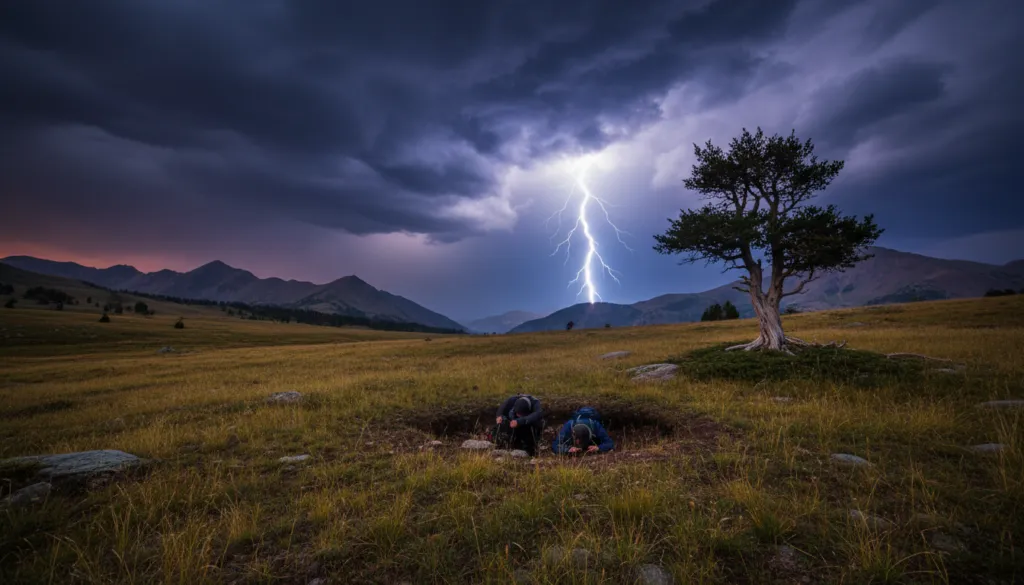
- As a last resort, crouch with your feet together, ideally on a rucksack or sleeping mat, head low. Do not lie flat.
- In a group, spread out more than ten metres apart so one strike cannot hit everyone.
- Count the seconds from flash to thunder and divide by 3 to get the distance in kilometres.
- Wait 30 minutes after the last thunder before going back out.
- A person struck by lightning is safe to touch. Not breathing? Call 112 and start CPR straight away.
How close is the storm? (flash to thunder)
| over 30 s | More than 10 km. The storm is coming. Start heading down and look for shelter. |
| 15–30 s | 5–10 km. You are within reach of lightning. Go to a building or car now. |
| 5–15 s | 2–5 km. Very dangerous. Leave open ground, get out of the water. |
| under 5 s | Under 2 km. The storm is over you. Crouch low, feet together, away from trees and metal. |
Sound travels about 1 km in 3 seconds. Lightning can strike 10–15 km from a storm, so nowhere outdoors is safe while you can hear thunder.
When to call 112
When someone has been struck by lightning, even if they seem fine. Immediately if they are not breathing.
What not to do
- Do not shelter under a lone tree or an open shelter in an open area.
- Do not stay on a summit, a ridge or by water.
- Do not hold trekking poles, an umbrella or a fishing rod above your head.
- Do not wait for the rain. Lightning can strike more than ten kilometres ahead of a storm.
See also
Frequently asked questions
Thunderstorm outdoors: what should I do first?
Hear thunder? You are within reach of lightning. Go into a building or a closed car with a metal roof now. In the mountains get off ridges and summits and away from chains, ladders and metal railings. Get out of the water, off boats and off open fields.
When should I call 112?
When someone has been struck by lightning, even if they seem fine. Immediately if they are not breathing.
Thunderstorm outdoors: what should I avoid?
Do not shelter under a lone tree or an open shelter in an open area. Do not stay on a summit, a ridge or by water.
📩 Free 72-hour plan by email
A 72-hour shopping and go-bag list, plus a short monthly checklist. Free, no spam.
Keep it on your phone
SurvivalZone.app is a free app for every emergency, with no account and no app store. It works without internet and shows the nearest shelters and help points, local radio, a 72-hour plan and a mountain trip planner.
Thank you for reading. If this could help someone, send it to the people you care about. Getting ready takes a moment, and in a crisis every minute counts.
Coming soon: the app’s permanent address will be survivalzone.app.
Other scenarios
- ⚡ Power cut
- 🥶 Cold, no heating
- 🚱 No water or unsafe tap water
- 🌊 Flood, water coming in
- 🎒 Evacuation in 10 minutes
- 🔥 Fire in the building
- 🌡️ Heatwave
- ⛈️ Storm, strong wind
- 🚀 Air attack: missiles, drones, bombs
- 📢 Sirens, alarm, air contamination
- 📵 No signal, no internet
- ❤️ Someone is unconscious
- 🌍 Earthquake
- ⛵ Storm at sea, no internet
- 🚗 Road accident
- ☠️ Carbon monoxide or gas leak
- ❄️ Stuck in a car in a snowstorm
- 🫀 Heart attack or stroke
- 🏊 Someone is drowning
- 🌲 Forest or grass fire
- 💳 Cards and cash machines not working
- 🦠 Epidemic, pandemic, dangerous disease
- 🧒 A child is missing
- 🫁 Choking
- 🩸 Severe bleeding
- 🔥 Burns and scalds
- 😷 Smog and poor air quality
- 🐻 Bear on the trail
- 🐗 Wild boar encounter
- 🏢 Fire at work: evacuation
- 🌪️ Tornado
- 🌧️ Flash flooding
- ☣️ Chemical incident
- 🏠 Quarantine at home
- 🛡️ Cyberattack
- 🔌 No power in your home
- 💨 You smell gas
- 😵💫 Someone faints
- 🏫 Alarm or evacuation at your child's school
- 🏜️ Drought and water restrictions
- 🌋 Volcanic eruption and ashfall
- 🛴 E-scooter accident
- 🛑 Attacker at school or in a building
- 🔔 An alarm goes off: home, flats, work
- ☢️ Nuclear attack and radioactive contamination
- 🧫 Suspicious package, powder, biological threat
- 💣 Bomb threat, suspicious item, explosion
- 💰 Robbery: shop, bank, street
- 💚 Suicidal thoughts: how to help yourself or someone else
- 🌲 Lost in the forest: how to survive
- ✈️ Diverted or cancelled flight, closed airport
- 🚨 Shooting or terrorist attack in a public place
Sources
- ERC first aid and resuscitation guidelines (European Resuscitation Council)
- IMGW-PIB: weather and flood warnings (Poland)
- TOPR: Tatra mountain rescue
Official sources are checked automatically every day. Last check: 2026-11-08.
General guidance only; it does not replace the emergency services. If a life is in danger, call 112.
© 2026 SurvivalZone.EU. Copying this content without permission is prohibited. When quoting, credit the source and link back.